Friday, December 4, 2020

Socratic Seminar - Community/Justice


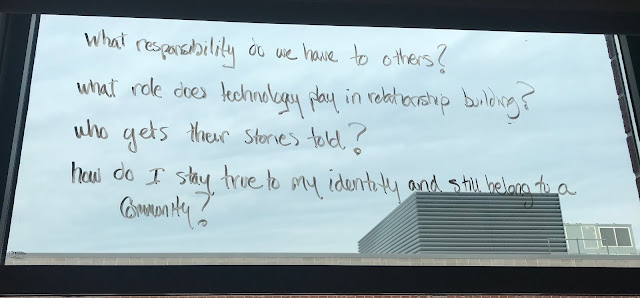
Why do we feel the need to belong? 

How do we maintain our individual identities and be part of a community?

What are the benefits and drawbacks of belonging to a community? 


Considering the pieces we read in the second unit, how do the texts we have discussed, or that you have explored on your own, help you to answer the driving questions of the unit?

Long Way Down
On Cracking White City
Danger of a Single Story

-ALSO-

Be able to make connections from the stories you have read, consider:

🌍      -text to world
👍👍 -text to self
📖      - text to text


Always use evidence from the book/text to prove your point – and cite the page number!

Be a good participant by sticking to the Excellent criteria of the rubric below.


We will arrange into three groups and each group will have about 25 minutes to discuss the driving questions with their group.  The Inner Circle will be discussing while the Outer Circle will be evaluating.


Thursday, September 10, 2020

Heroes We Never Name | The Man in the Red Bandana

Heroes We Never Name By M. Lucille Ford

Back of the men we honor

Enrolled on the scroll of fame,

Are the millions who go unmentioned -

The heroes we never name!

Those who have won us the victories,

And conquered along the way;

Those who have made us a nation -

A tribute to them I would pay.


Back of our nation's first leader,

Of Lincoln and Wilson, too,

Back of the mind directing our course

Was the army that carried it through.

Back of the generals and captains

Was the tramping of rank and file,

And back of them were the ones at home

Who labored with tear and with smile.


And What of the "everyday" heroes

Whose courage and efforts ne'er cease!

Toilers who struggle and labor and strive

And hope for a future of peace?

Hats off to the worthy leaders;

Their honor I'd ever acclaim -

But here's a cheer for the many brave,

The heroes we never name.


Analysis Questions

What is the poem about? 

What is the message of the poem? 

What is the tone? Mood? 

Poetic devices: ­
Look for figurative language and sound devices. Alliteration

  • Assonance

  • Consonance

  • Onomatopoeia

  • Allusion 

  • Symbolism ­

What do you think it all means? 


Look at the graphic elements in the poem.

  • Capitalization

  • Punctuation ­

  • Line breaks

  • Word position/White space


Friday, August 28, 2020

Hack This Class

  • Publish your work!  Share/Post more of your best quality work on this blog on other publishing venues.  This should be work that you are most proud of and is worthy of exhibition.
  • Write, sketch, draw, create, compose, color in your writer's notebook daily.
  • Revise, resubmit, and take advantage of reading/writing conferences – your commitment to the Process Writing Project gives you complete control of your grade in this class.
  • Constructively comment on your classmates' posts.  The blog is a valuable extension of the classroom.  Be an active participant.
  • Read as many books as you can, keep a record of what you read, and talk about them in class.
  • Always use evidence from the book to prove your point – and cite the page number!
  • Check the syllabus or just ask if you have questions:

Monday, March 23, 2020

Dear Seniors,

Dear Seniors,


It is with a heavy heart that I send this message. As I heard the news that school closed for the rest of the year, my thoughts immediately turned to you. I know that you are processing today’s news as well, but I want you to know that I think the world of you. I got so lucky to have met you. I can’t help but think how in all the turnings of life we got matched up. Prior to this year, I had only taught Freshman and Creative Writing, so some of us had already gotten to know each other in those classes. This year, I thought it would be cool to teach Seniors as well - help with Capstone, see you all dressed up at prom, hugs at graduation. My request was granted, and I find it unfathomable that if that had not happened I never would have met, or gotten to know better, some of you. With my good fortune of meeting you stated, I am not writing this as a goodbye, but as a see you soon. I plan to be your teacher forever if you will have me. I don’t know what this next phase of our teacher-student relationship will look like, but I hope that you will go all-in with me. I am going to work as hard as I can to make our remaining time together meaningful, fun and engaging as I can, and I hope that you will come along with me.


Much Love,


Paul Koch

Monday, March 16, 2020

Dear Students, I Miss You.

Hey guys, I trust that you are well and spending some time resting and taking good care of yourself and the people around you. I hope that you are safe and healthy and finding time to do things that matter to you! I have been okay, a little bored already, but okay. I have been going for a morning walk - usually about 5 miles/day with my dog Katy.


While walking I mess around with PokemonGO. I know that ya’ll think that is corny, but it keeps me moving on my walk - Gotta Catch 'em All!

In case you know… 

I have tried a few other things to try to stay busy and feel productive. I challenged myself to do the following each day, and I even made a little chart in my notebook to track my success(or struggles) each day. 

Read - I am currently reading 2 books - We are Not Yet Equal by Carol Anderson and The Sixth Extinction by Elizabeth Kolbert.  I try to read for at least 1 hour a day, usually breaking it into smaller portions. I am also jotting down quotes and making 2 Page Spreads of the books I am reading. This helps me learn but also gets me doing some fun artwork while I am at it. 


Write - I am keeping a journal of these interesting times - I call it my CoronaVirus Isolation Journal. There is no doubt that your children or grandchildren are going to study this interesting time; if you have found enjoyment in writing in your journal this year in class, write during this time as well. What you write, both the words and your document will be a help to you as you share with future people “what it was like in isolation” during 2020. They will want to read the words about what you were thinking, feeling - how life had changed for you rather abruptly. I just try to write the things that I am doing each day, my feelings, what I see and observe, what I read in the news - even though I have made a big effort to only take in news at certain times a day so that I don’t get overwhelmed by too much bad news. But while I was looking at the news today, I found this article very interesting. 


Exercise - Mostly just the walks mentioned above - but walking is both healthy and therapeutic, and it can be done while remaining a good distance from others. 

Drink at least 64oz of water - I drink a lot of water at school during the day and I have noticed that if I forget to have my water bottle with me at home, I will forget to drink water. So, I have made it a point to record in my journal how much water I am drinking each day. 

Make and Drink a Wellness Shot - Ginger, Turmeric, Lemon Juice - I learned to make this on TikTok. I had never heard of it, and I am sure that I would never have discovered it if it weren’t for concern for my immune system during this time, but it is kind of fun to make, tastes a little rough, but it does make me feel good. I am not sure if there are any real health benefits, but who knows. I’ll send you a recipe if you want it. 


Cook - I made some homemade Popeye's Spicy Chicken Sandwiches yesterday.

 Tonight I am grilling a whole Rock Fish - I am excited about it! What you think?

Well, that is what I am up to, and I mostly just wanted to check in with you.  Please know that I would love to hear from you in some capacity.

I have an Instagram account for school use and you can DM me @irockenglish, maybe I'll host some daily lives.

Also, you can try Skype or Google hangouts at paul.koch@lcps.org

Of course, you can always email me or post in classroom, I will get back to you as soon as possible.

XO,

PK

Friday, February 7, 2020

"We should applaud and praise the iconic moments and achievements of Google’s #TheMostSearched—but as these talented Americans entertain, enlighten, educate, and inspire us as we watch this video, we must embrace their complex fullness and revere their observations of how America remains a work in progress. They are the unflinching mirror to America’s visage, and we as a nation will not fulfill our greatest potential until we can look at all aspects of our history." from https://spokesman-recorder.com/2020/02/06/googles-black-history-ad-is-cause-for-reflection/ by Dr. Richard Reddick @DrRichReddick

Thursday, February 6, 2020

Peer Revision Norms

73AiDfT6-sq5CCcqzoClidMnTU5Sw2yJfchPjkF5D3eh=w727-h545-no


Step 1: Writer introduces assignment to reviewer(s).

  • What is the purpose of this writing?
  • What do you consider the strengths of this writing?
  • What are your concerns, if any, about the writing at this point?
  • Describe the revision and editing that you have done on this paper.


Step 2: Choose one method agreed upon in class.

  • Share Paper
  • Read Aloud
  • Comment - Positive and Constructive
  • Discuss and take notes


Step 3: Constructively review for the key questions below, the concerns of the writer, or share any other feedback. Be positive, be helpful, be a writing teammate.


Did the writer stay focused and share original and fresh information or perspective about the topic?

Does the organizational structure enhance the ideas and make it easier to understand? Or does it overpower the ideas like too much perfume in a crowded elevator?

Would you keep reading this piece if it were longer? Much longer?

Do the words and phrases create vivid pictures in the reader’s mind?

Can you feel the words and phrases flow together as you read it aloud?

How much editing would have to be done to be ready to share with an outside source?

Tuesday, December 10, 2019

Socratic Seminar - The Kite Runner

On 12/17(a) and 12/18(b) we will have a Socratic Seminar in class to discuss The Kite Runner. Be able to make connections to the book, consider:

🌍 -text to world
👍👍 -text to self
📖 - text to text

Using our discussion of theoretical lenses, develop insightful, original analyses for each of the questions below. In your responses, you will use textual evidence from the book to support your points, but feel free to be as creative and insightful as possible with your analysis. The important thing is you must support your answers with textual evidence or outside research.


Always use evidence from the book/text to prove your point – and cite the page number!

Be a good participant by sticking to the Excellent criteria of the rubric below.


We will arrange into small groups and each group will have about 30 minutes to discuss the questions with their group. The Inner Circle will be discussing while the Outer Circle will be evaluating.


  1. Can you diagnose any of the characters with a mental disorder or mental pathology? If so, whom and why? More importantly, why would the author include this character in the story? That is, how does this character’s mental pathology contribute to an important theme or conflict in the book?

  1. Some argue that this book incorrectly characterizes Afghanis as either radical terrorists or helpless victims who are reliant on outside help to ameliorate their own domestic problems. What do you make of Hosseini’s characterization of Afghanis and Islam? Does he portray Muslim Afghanis as weak, powerful, or simply human? Support your answer with direct quotes from the text and statistics on the War Against Terrorism?

  1. Below is a list of secondary characters in the book. Choose one of the characters and explain how he or she is thematically important. That is, characters in books are often representative of entire populations or groups of people, so which group do you think your character represents, and why is this important to consider when reading The Kite Runner? 
Secondary characters to explore (Who do they stand for?):
  • Rahim Khan
  • Farid
  • Sanaubar(Sasa), Hassan’s mom and Sohrab’s grandmother
  • Kamal and Walid, Assef’s friends
  • Soraya, Amir’s wife (you’d have to read a little on your own).
  • Secondary characters in Afghanistan (taxi drivers, the beggar who knows Amir’s mother, the young boy selling “sexy pictures”)
  • The children of Afghanistan

  1. Finally, and most importantly, what did you ultimately learn from The Kite Runner? Please look at our opening day activity questions below, and explain how this book either changed (or didn’t change) your perspective regarding your initial stances on these questions. Also, do you think this book should be banned from the classroom? It certainly is one of the most controversial books in our curriculum, so explain why we should or should not continue teaching it as a whole-class text. 


1. If you have betrayed a friend, it is always possible to make up for that somehow.


2. The negative actions of our past will always haunt us; there is no way to entirely repent for our past sins.


3.  Your race, culture, and class—not your own individual choices—effectively determine your personality, habits and values.


4. In America, movies, television shows, and books do not intentionally or unintentionally perpetuate racial stereotypes. Stereotypes are formed and popularized by other forces.

Monday, December 2, 2019

Of Mice and Men by John Steinbeck


https://www.history.com/topics/great-depression/dust-bowl


List 5 stereotypes for men and 5 stereotypes for women. Where do stereotypes come from?

What is empathy? Is it an important human characteristic?

Why is it important to society for people to be accepting of those who are different? What lessons can we learn from those whose live lives different from our own?

What is an individual’s duty to others?

Why is it important for people to feel like they belong?

What can the struggles of others teach us about ourselves? How can people’s struggles define who they become?

What are the elements that build a strong friendship? How are people transformed through their relationships with others? How do you know if a relationship is healthy or hurtful?

Can mercy killing be justified?

How are the experiences of migrant workers similar to what people go through today?

What is the American Dream and to what extent is it achievable for all Americans? In what ways does the American Dream mean different things for different Americans?


Soledad, California


'via Blog this'

Tuesday, November 19, 2019

Six-Word Memoirs: Life Stories Distilled : NPR


http://www.sixwordmemoirs.com/
Once asked to write a full story in six words, legend has it that novelist Ernest Hemingway responded: "For Sale: baby shoes, never worn."

In this spirit of simple yet profound brevity, the online magazine Smith asked readers to write the story of their own lives in a single sentence. The result is Not Quite What I Was Planning, a collection of six-word memoirs by famous and not-so-famous writers, artists and musicians. Their stories are sometimes sad, often funny — and always concise.

The book is full of well-known names — from writer Dave Eggers (Fifteen years since last professional haircut), to singer Aimee Mann (Couldn't cope so I wrote songs), to comedian Stephen Colbert (Well, I thought it was funny).

The collection has plenty of six-word insights from everyday folks as well: Love me or leave me alone was scrawled on a hand dryer in a public bathroom; I still make coffee for two was penned by a 27-year-old who had just been dumped.

Larry Smith, founding editor of Smith magazine, and Rachel Fershleiser, Smith's memoir editor, talk about the experience of capturing real-life stories in six words — no more, no less.Fershleiser's six-word memoir? Bespectacled, besneakered, read and ran around. And Smith's: Big hair, big heart, big hurry.


Six-Word Memoirs: Life Stories Distilled : NPR:


'via Blog this'

Friday, November 15, 2019

Poetry Outloud


Thanks Mrs. Whittington - blog post adapted from http://whittenglish9.blogspot.com/search/label/PoetryOutLoud


Your assignment is to memorize/present a poem as part of our class poetry slam.

If you would like to compete in the Poetry Out Loud National Competition, your poem must be from the anthology list and must be memorized.

If you do not want to compete beyond the classroom, the poem does not have to be from the anthology, but it must be approved by your teacher and must be a minimum of 10 lines. Presentation does not have to be completely memorized. 


Links:
Poetry Out Loud Poem Options (Required for National Competition)
Can We AutoCorrect Humanity?
Why I Hate School But Love Education
On Girls Lending Pens

Button Poetry is a great resource for ideas on spoken word poetry


Important Dates:
- Starting today - choose a poem to memorize
- Rehearse your memorized poem in class in small groups for the next week.
- Perform poem in class 12/2-12/5


How you will be Graded(in competition):


Wednesday, November 6, 2019

Socratic Seminar - Identity


Considering the pieces we read in the first quarter, how do the texts we have discussed, or that you have explored on your own, help you to answer the driving questions of the unit?


What role do other people play in constructing your identity?

How do our successes/failures shape our identity?

How does your identity change over time?

-ALSO-

Be able to make connections from the stories you have read, consider:

🌍      -text to world
👍👍 -text to self
📖      - text to text


Always use evidence from the book/text to prove your point – and cite the page number!

Be a good participant by sticking to the Excellent criteria of the rubric below.


We will arrange into three groups and each group will have about 25 minutes to discuss the driving questions with their group.  The Inner Circle will be discussing while the Outer Circle will be evaluating.


Featured Post

Socratic Seminar - Community/Justice

Why do we feel the need to belong?  How do we maintain our individual identities and be part of a community? What are the benefits and draw...