Showing posts with label Research Based BQ Essay. Show all posts
Showing posts with label Research Based BQ Essay. Show all posts
Tuesday, January 28, 2020

Wednesday, January 2, 2019
Does Anything Matter?
Nihal Boina
Does Anything Matter?
Imagine spending your whole life working up to something very important to you and then one day realizing that none of it mattered, because your end goal did not have an appreciable effect on the world, much less the universe. Almost everyone has had, or will have, the thought of ‘Does anything we do matter?’; it’s a question that many spend their whole lives attempting to answer. This question is of top importance because if nothing did matter, then there would be no point of living life. When considering that we are pretty much nothing when compared to the everything surrounding us, the afterlife, the butterfly effect, and the Uncertainty Principle, I believe that there is no answer to the question. Instead of attempting to answer the question, we should choose to believe that life does matter, even if it doesn’t, because every living being would benefit.
Sometime in the 1920s, Edwin Hubble made the astonishing discovery that the universe is expanding, and at an increasing rate, or an acceleration, which basically meant that as time progresses, our presence in the universe becomes less and less noticeable. I currently occupy a space of around 24 cubic feet. The universe, on the other hand, is of a space of around 408 sextillion cubic light years (keep in mind that one light year is 31,039,141,970,400,000 feet). Through extensive calculation, this puts me as occupying 6.106 * 10-57 % of the universe-- .00000000000000000000000000000000000000000000000000000000006106. On top of this, there is also the possibility that there could be an infinite number of universes, which would make me 6.106 * 10-57 % of a grain of sand in the biggest beach ever; we are just too small in order to make any sort of appreciable change in our surroundings.
Put simply, life only matters if there is some sort of afterlife that becomes more pleasant/harsh based on our actions in the physical life; this is because if there isn’t some sort of afterlife that acts in this way then that would mean that our choices made in our physical life (our only life) wouldn’t have any, real, long-term repercussions. The reason why this is being brought up is because right now there is no concrete evidence for how an afterlife would exist and why an afterlife would exist for us, because, we are infinitesimally small when compared to everything. Even if an afterlife existed, it wouldn’t remain permanently because not even the universe is permanent, and will likely end itself through a heat death in about 101000 years due to the decaying of protons; this is contradicting to the whole idea of an afterlife because an afterlife is supposed to last forever.
The butterfly effect is the phenomenon that even the smallest actions in one moment of time can have the greatest effects in the future relative to that moment of time. It’s represented through the book 11/22/63 in which a young man named Jake finds a wormhole that brings him back to the year 1958, where he prevents the assassination of JFK, believing that he will make a positive change in the world. However, after taking out Lee Harvey Oswald and returning to his original time, he found earthquakes everywhere, half of the world destroyed due to a nuclear war, and his old home destroyed. Even the smallest actions, like the presence of a butterfly can have the greatest, most arbitrary effects. Because of the butterfly effect, it would be reasonable to believe that even the smallest actions that we have could make huge ripples in space-time.
In a book that I am currently reading, Stephen Hawking’s A Brief History of Time, the fabulous Stephen Hawking talks about something called Heisenberg’s Uncertainty Principle and how it changed our perception of the universe completely. Back in the 1900’s Newton’s laws of motion gave rise to the philosophy of determinism-- the idea that every action that we do can be predicted. What determinism meant was that nothing we do matters because every action we take can be determined; what is the point of living life if you already know the end result? Eventually, Werner Heisenberg came along with the Uncertainty Principle. What the Uncertainty Principle says is that we can’t know both the present position and velocity of a particle accurately because the more we know of one, the less we can now of the other; this meant that determinism is wrong, and that it’s impossible to accurately predict the actions of all parts of the universe.
From here on out, the evidence for whether or not anything we do matters tends to delve more and more into pseudoscience, or areas that can not be solved through the application of the scientific method (like astrology or religion), so I will have to solve this question through taking a step back. Let’s analyze what the universe would turn out to be if every intelligent living being believed in the idea that nothing matters vs. what the universe would turn out to be if every intelligent living being believed in the idea that everything matters. Through extensive analysis, if everyone believed that nothing matters, the universe would turn into a place of destruction, disorder, nihilism, and pessimism, proving bad for everyone. If everyone believed that everything we do matters, the universe would turn into a place of peace, pleasantry, order, and optimism, proving helpful for everyone.
When considering the arguments of expansion of the universe, the afterlife, the butterfly effect, that we choose our own fate, and the analysis of what would happen if everyone believed that nothing matters, I conclude that there is no answer to whether or not anything we do matters. Our physical life is very short as is and if we spend the majority of it searching for an answer we probably won’t ever find then we will miss out on most of the joys of life. Live life as if it matters, even if it doesn’t, because of the effects that it would pose on the the universe.
Works Cited
Hawking, Stephen. A Brief History of Time. Bantam Books, 2017.
King, Stephen. 11/22/63: Part 1. Scribner, 2011.
Wednesday, November 1, 2017

Monday, April 27, 2015
Friday, April 17, 2015
Tuesday, March 17, 2015
Elephants in the Sky
Imagine 6.5 billion female elephants in the sky every year. Now imagine that every person in the US was responsible for 5 of those elephants up there while people in third world countries each put up 5 baby elephants. This may be a farfetched thought, but now imagine each of those elephants being made out of carbon dioxide. This is how much CO2 is in the sky. Let me reiterate: every year, twenty six billion tons of CO2 is put into the atmosphere each year. And Americans put an average of twenty tons of this noxious smog there, while each person in a third world country puts about one ton. This is a severe problem, as we have climate change occurring so much to the point that the Dead Sea may be completely evaporated by 2050 (Deal Could 'refill' Drying Dead Sea.) The world still needs energy, however, and third world countries need it even more than anyone else in the world in order to have a good future. So how do we solve this dilemma?
Recently, hydraulic fracking has been on the news for giving us a great amount of oil and it is great that there is more energy available, but this is causing people not to worry about energy problems. On the down side, oil can last for only so long and shale oil may only last until 2020. Even further, oil itself may only last until 2040, giving us less than 26 years to put our act together and find a solution. (Dimick, Natural Geographic) Along with this, communities surrounding oil fracking areas have reports of poisoned drinking water, polluted air, mysterious animal deaths, industrial disasters and explosions. (Fracking Across the United States)
Looking at this prospect, we have to find a solution to lower the amount of carbon dioxide put into the air as close as we can get to 0. This can be found through simple multiplication; the formula is the amount of people times the amount of services used, times the energy each service takes, times the amount of CO2 released through the service. (Gates, TED)
In the formula, we first have the amount of people on the planet. We know that we cannot somehow rid the Earth of people, so this number will either stay the same or go higher. Next, we have the amount of services that each person receives. These services may be having enough drinking water, being able to have light at night, or even being able to cook food. We could remove these services, but it would be harmful toward society, especially to poorer countries where having simple pleasures such as food or light are difficult.
Thirdly, the amount of energy services are taking is generally going down, which is a good thing. We have cleaner cars, televisions that use less power, and more cleaner forms of electricity coming out, such as solar or wind power. At the same time, we have services that are using too much energy such as making fertilizer or burning coal. Therefore, this may lower the overall number, but it is going to make a small difference.
Finally, we come to the last variable in this problem: the amount of carbon dioxide released by the service . Inside any multiplication equation, in order to have a result of zero, it is required to have a zero in the equation. What’s great is that it is possible to bring the amount of carbon dioxide required down to zero! However, in order to accomplish this, we need to have energy breakthroughs, and we need it fast. There are many possibilities, but the ones that seem to have the most promise are nuclear energy and renewable energy. However, if there happens to be more successful sources of clean energy, then the better it will be. But once again, at this time, these sources seem to be the most promising.
In the field of Nuclear Energy, many major innovations are being made as a company called Transatomic Power, founded by 2 graduates from the Massachusetts Institute of Technology, have possibly found a more efficient method of energy creation. Nuclear energy creates a lot of toxic waste. What Transatomic Power has done is find a way to convert this once thought useless sludge to an abundance of energy. In fact, Cofounder of PayPal, Peter Thiel has invested more than a billion dollars to Transatomic Power. (Kim, Business Insider) This is the kind of action that we need in order to move forward in society.
In the field of renewable energy, there is an abundance of potential for success. However, compared to oil, these renewable energies only give a fraction of power. Research needs to be done in order to increase efficiency of this type of power. For example, wind power generates less than 5% of the energy that oil provides us. There is much work that can be done in this field, but if it works then, it will be very beneficial toward the future of energy.
In the end, we need to reduce the amount of CO2 in the air. Along with that, we need innovations that can take us there. We may find more ways to obtain oil, but there must be a better method that can be found in order to not only help this country, but the whole world. And we have to do it fast. We cannot have anymore elephants in the air. Not even one.
Bibliography
"Bakken Shale Oil." The New Oil Landscape. Web. 4 Feb. 2015.
"Deal Could 'refill' Drying Dead Sea." BBC News. Web. 4 Feb. 2015.
Dimick, Dennis. "How Long Can the U.S. Oil Boom Last?" National Geographic. National
Geographic Society, 19 Dec. 2014. Web. 4 Feb. 2015.
“Fracking Across the United States." Earthjustice. 12 Apr. 2011. Web. 27 Feb. 2015.
Gates, Bill. "Innovating to Zero!" Bill Gates:. TED Talks. Web. 4 Feb. 2015.
Kim, Eugene. "Billionaire Investor Peter Thiel Now Wants To Disrupt The Nuclear Energy
Industry." Business Insider. Business Insider, Inc, 5 Aug. 2014. Web. 4 Feb. 2015.
SeaWorld. "Elephants." SeaWorld Parks and Entertainment. SeaWorld Parks and
Entertainments. Web. 4 Feb. 2015.
"When Will Oil Run Out?" When Will Oil Run Out? Web. 4 Feb. 2015.
Tuesday, January 13, 2015
The Right to Be Forgotten?
The “right to be forgotten” from Internet
searches ought to be a civil right.
By:
Sreya Palnati
I think that the right to be forgotten from internet searches
is needed and necessary. This is because
people should have control over their personal information, and because of the
fact that privacy is fundamental.
First of all, people should have control over their personal
information and who gets to see it. 86%
of internet users have taken steps online to remove or mask their digital
footprints—ranging from clearing cookies to encrypting their email, from
avoiding using their name to using virtual networks that mask their internet
protocol (IP) address. 55% of internet users have taken steps to avoid
observation by specific people, organizations, or the government, according to
pewinternet.org. Many others who see these statistics think that people
have control over the information they post on the internet. But the
truth is that most of these people who have taken these careful steps still
aren’t fully secure. Anyone can still look at their personal information
anytime. Especially with today’s increasing knowledge about hacking
systems, etc., many people will know how to use this information to hurt
others. Instead, these are the facts that are really important to know.
21% of internet users have had an email or social networking account
compromised or taken over by someone else without permission. 11% of
internet users have had important personal information stolen such as their
Social Security Number, credit card, or bank account information. All of
these facts/evidence lead to the conclusion that most people might think that
their personal information is secure, but it actually isn’t. Without
having the right to be forgotten, the majority of the population will continue
to be cheated online. That is one of the reasons as to why having the
right to be forgotten on the internet is needed.
Also, privacy is fundamental. Fundamental rights are a generally regarded
set of legal protections in the context of a legal system, wherein such system is itself based upon this same set of
basic, fundamental, or inalienable rights. When people don’t have privacy, they often don’t feel
secure. They feel as if they have been exploited and everyone can look at
them, which is very true. This makes people be less honest on what they
post on the internet, which could lead to very bad consequences, depending on
the scenario. That is why privacy is so important and therefore a
fundamental right. Having the right to be forgotten would lead many
people to be more open about what they say and the internet would be a
comfortable environment for people to post in.
Additionally, the
right to be forgotten violates property rights. “Personal data and
information is property” -shatterthelens.com. Just because someone posts
something on the internet, it doesn’t mean that anyone can use that information
in any way they like. “When you are online, you provide information to
others at almost every step of the way.” says privacyrights.org. For
example, if you give a website some of your personal information, you are
providing information to others. Teen Twitter use has grown
significantly: 24% of online teens use Twitter, up from 16% in 2011, according
to pewinternet.org. This is especially bad because teens are now sharing
more personal information than they did before. This risks their safety.
If there was the right to be forgotten on the internet, this wouldn’t be
a problem. Also according to pewinternet.org, teen social media users do
not express a high level of concern about third-party access to their data;
just 9% say they are “very” concerned. We wouldn’t have to waste money on
teaching these teens to be careful on what they post on the internet if there
was the right to be forgotten on internet searches.
People should have control over their personal information,
privacy is fundamental, and the right to be forgotten violates property rights.
Therefore, the right to be forgotten from internet searches ought to be a
civil right.
Works Cited:
"Basic Privacy Rights." Privacy Rights
Clearinghouse. Web. 14 Dec. 2014. <http://www.privacyrights.org/>.
"Privacy Rights Statistics." Pew Research
Centers Internet American Life Project RSS. Web. 14 Dec. 2014.
<http://www.pewinternet.org/>.
""Right To Be Forgotten From Internet
Searches"" Shatterthelens. Web. 14 Dec. 2014. <http://www.shatterthelens.com/>.

Subscribe to:
Posts (Atom)
Featured Post
Socratic Seminar - Community/Justice
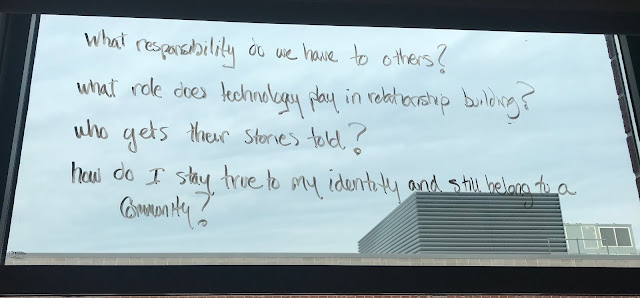
Why do we feel the need to belong? How do we maintain our individual identities and be part of a community? What are the benefits and draw...
-
Publish your work! Share/Post more of your best quality work on this blog on other publishing venues. This should be work that you are mo...
