Tuesday, January 28, 2020

Tuesday, December 10, 2019
Socratic Seminar - The Kite Runner
On 12/17(a) and 12/18(b) we will have a Socratic Seminar in class to discuss The Kite Runner. Be able to make connections to the book, consider:
🌍 -text to world
👍👍 -text to self
📖 - text to text
Using our discussion of theoretical lenses, develop insightful, original analyses for each of the questions below. In your responses, you will use textual evidence from the book to support your points, but feel free to be as creative and insightful as possible with your analysis. The important thing is you must support your answers with textual evidence or outside research.
Always use evidence from the book/text to prove your point – and cite the page number!
Be a good participant by sticking to the Excellent criteria of the rubric below.

We will arrange into small groups and each group will have about 30 minutes to discuss the questions with their group. The Inner Circle will be discussing while the Outer Circle will be evaluating.

Always use evidence from the book/text to prove your point – and cite the page number!
Be a good participant by sticking to the Excellent criteria of the rubric below.

We will arrange into small groups and each group will have about 30 minutes to discuss the questions with their group. The Inner Circle will be discussing while the Outer Circle will be evaluating.
- Can you diagnose any of the characters with a mental disorder or mental pathology? If so, whom and why? More importantly, why would the author include this character in the story? That is, how does this character’s mental pathology contribute to an important theme or conflict in the book?
- Some argue that this book incorrectly characterizes Afghanis as either radical terrorists or helpless victims who are reliant on outside help to ameliorate their own domestic problems. What do you make of Hosseini’s characterization of Afghanis and Islam? Does he portray Muslim Afghanis as weak, powerful, or simply human? Support your answer with direct quotes from the text and statistics on the War Against Terrorism?
- Below is a list of secondary characters in the book. Choose one of the characters and explain how he or she is thematically important. That is, characters in books are often representative of entire populations or groups of people, so which group do you think your character represents, and why is this important to consider when reading The Kite Runner?
Secondary characters to explore (Who do they stand for?):
- Rahim Khan
- Farid
- Sanaubar(Sasa), Hassan’s mom and Sohrab’s grandmother
- Kamal and Walid, Assef’s friends
- Soraya, Amir’s wife (you’d have to read a little on your own).
- Secondary characters in Afghanistan (taxi drivers, the beggar who knows Amir’s mother, the young boy selling “sexy pictures”)
- The children of Afghanistan
- Finally, and most importantly, what did you ultimately learn from The Kite Runner? Please look at our opening day activity questions below, and explain how this book either changed (or didn’t change) your perspective regarding your initial stances on these questions. Also, do you think this book should be banned from the classroom? It certainly is one of the most controversial books in our curriculum, so explain why we should or should not continue teaching it as a whole-class text.
1. If you have betrayed a friend, it is always possible to make up for that somehow.
2. The negative actions of our past will always haunt us; there is no way to entirely repent for our past sins.
3. Your race, culture, and class—not your own individual choices—effectively determine your personality, habits and values.
4. In America, movies, television shows, and books do not intentionally or unintentionally perpetuate racial stereotypes. Stereotypes are formed and popularized by other forces.
Monday, December 2, 2019
Of Mice and Men by John Steinbeck

https://www.history.com/topics/great-depression/dust-bowl

List 5 stereotypes for men and 5 stereotypes for women. Where do stereotypes come from?
What is empathy? Is it an important human characteristic?
Why is it important to society for people to be accepting of those who are different? What lessons can we learn from those whose live lives different from our own?
What is an individual’s duty to others?
Why is it important for people to feel like they belong?
What can the struggles of others teach us about ourselves? How can people’s struggles define who they become?
What are the elements that build a strong friendship? How are people transformed through their relationships with others? How do you know if a relationship is healthy or hurtful?
Can mercy killing be justified?
How are the experiences of migrant workers similar to what people go through today?
What is the American Dream and to what extent is it achievable for all Americans? In what ways does the American Dream mean different things for different Americans?
 |
| Soledad, California |
'via Blog this'
Tuesday, November 19, 2019
Six-Word Memoirs: Life Stories Distilled : NPR

Once asked to write a full story in six words, legend has it that novelist Ernest Hemingway responded: "For Sale: baby shoes, never worn."
In this spirit of simple yet profound brevity, the online magazine Smith asked readers to write the story of their own lives in a single sentence. The result is Not Quite What I Was Planning, a collection of six-word memoirs by famous and not-so-famous writers, artists and musicians. Their stories are sometimes sad, often funny — and always concise.
The book is full of well-known names — from writer Dave Eggers (Fifteen years since last professional haircut), to singer Aimee Mann (Couldn't cope so I wrote songs), to comedian Stephen Colbert (Well, I thought it was funny).
The collection has plenty of six-word insights from everyday folks as well: Love me or leave me alone was scrawled on a hand dryer in a public bathroom; I still make coffee for two was penned by a 27-year-old who had just been dumped.
Larry Smith, founding editor of Smith magazine, and Rachel Fershleiser, Smith's memoir editor, talk about the experience of capturing real-life stories in six words — no more, no less.Fershleiser's six-word memoir? Bespectacled, besneakered, read and ran around. And Smith's: Big hair, big heart, big hurry.
Six-Word Memoirs: Life Stories Distilled : NPR:
'via Blog this'
Subscribe to:
Posts (Atom)
Featured Post
Socratic Seminar - Community/Justice
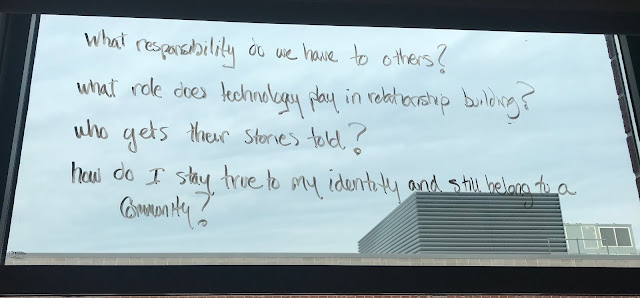
Why do we feel the need to belong? How do we maintain our individual identities and be part of a community? What are the benefits and draw...
-
Publish your work! Share/Post more of your best quality work on this blog on other publishing venues. This should be work that you are mo...
-
 You can see the full graphic novel of The Odyssey and other works at TumbleBooks.com login information below ...